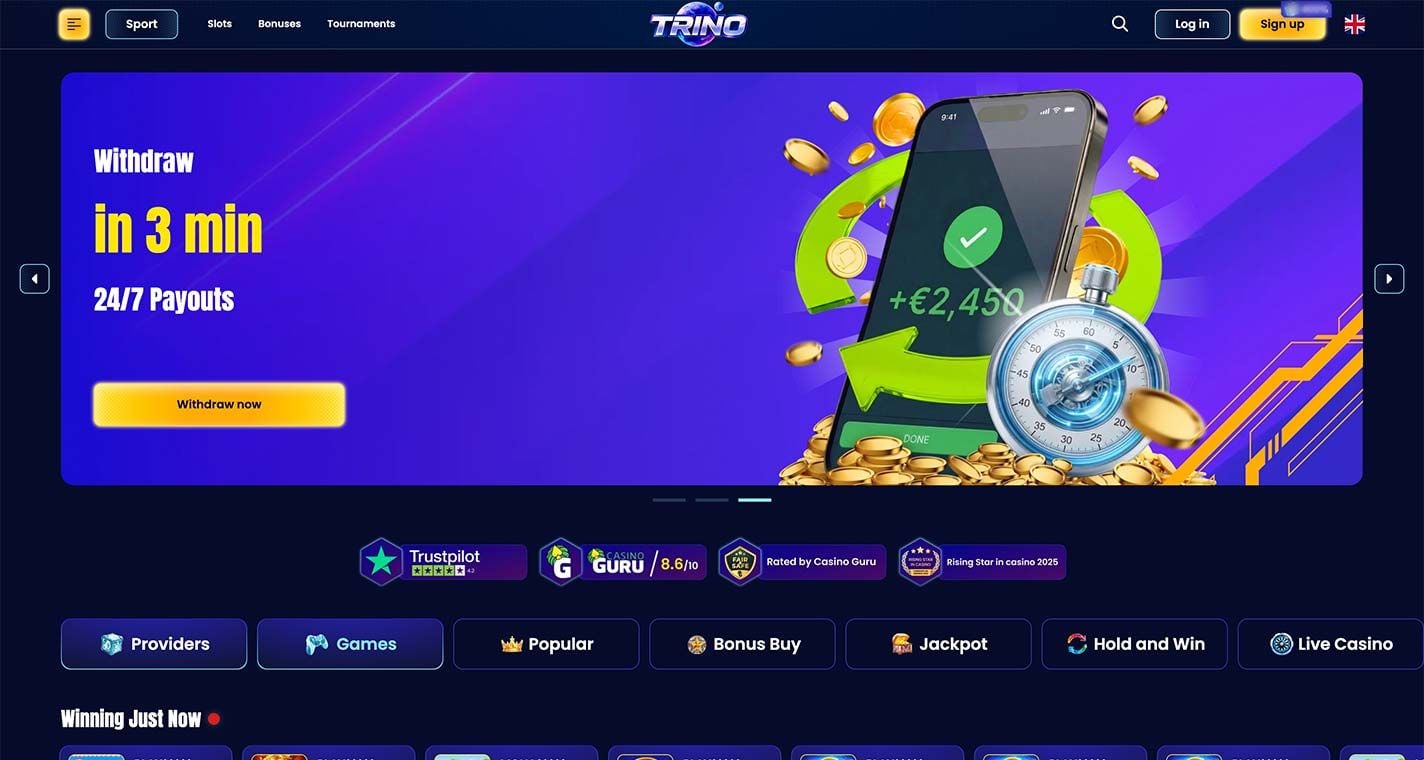
Trino Casino’s mobile app allows Italian players save favorite games close at hand while maintaining progress across sessions. The interface saves both quick links and entire game progress, so users are not required to browse the entire lobby whenever they open the phone. This article walks through the specific steps required to install and set up the app, outlines which devices are compatible, and shows how the saved games and saving systems actually work. Each section concentrates on a single practical or technical aspect so readers can judge whether the app suits their requirements before they proceed with a download.
Device Support and System Prerequisites
Trino Casino’s app targets two main operating systems: Android and iOS. On the Android side, the minimum supported version is 7.0 Nougat, but the current build is compiled against Android 11 APIs, which boosts reliability on devices running 12 or 13. Screen sizes from 5 inches upward are completely usable; smaller displays may display compressed graphics but still handle taps properly. RAM of at least 2 GB is suggested to keep live dealer tables and high-definition slots reactive at the same time. Apple users need iOS 13 or later; the binary is compiled for arm64, so both older A-series chips and the newest M-series iPads operate seamlessly. iPadOS 15 and 16 have been evaluated in split-screen mode, verifying that the lobby and game windows scale correctly when the tablet is rotated.
Hardware acceleration is mandatory https://trino-casino.org/it/app/. Devices without a dedicated GPU may suffer frame drops during animated transitions, although the core game logic runs without interruption. Storage checks are executed on launch; the installer reserves roughly 180 MB and then downloads an additional 120 MB of art assets the first time a slot or table is opened. If internal memory is low, the app provides the option to move the asset cache to an SD card on Android 10 and higher, but iOS users must rely on iCloud or device storage alone. Location services are requested only once, at first launch, to ensure regional compliance; after that, the setting can be deactivated without affecting gameplay.
Browsing the Lobby and Finding Preferred Games
The lobby is split into row-based carousels labeled “New,” “Popular,” and “Favourites.” The Favourites carousel updates on its own once a gamer has marked at least one slot; until then it keeps hidden to prevent empty space. Clicking the heart symbol on any game tile includes it to the carousel and at the same time writes an item to the gadget’s local SQLite system. Because the record is kept on the device, the set remains available even when the handset is in airplane mode, although starting the game itself will of course need connectivity.
Search feature sits at the top of the interface. Typing three symbols surfaces both exact title matches and fuzzy findings based on provider name. Filters can be combined: a gamer may select “Megaways” and “Volatility: High” at the same instance, then press the star icon to keep that filter set as a custom layout. Up to five custom views can exist together; attempting to create a new one triggers the user to erase an earlier one. Each saved layout is updated across phones once the profile is authenticated on another phone or iPad, so the same refined collection shows whether the gamer is at house on Wi-Fi or on the go on 5G.
Installing the App on Apple iPhones and iPads
Apple’s ecosystem restricts direct sideloading, so Trino Casino provides its iOS app through a signed configuration profile that needs to be installed via Safari. The user goes to the same download page used for Android, clicks the iOS button, and follows the on-screen prompts to add the profile. After the profile is added, the device presents a notification that an enterprise-signed application is ready; confirming the prompt begins the actual download from Apple’s CDN. The binary is approximately 95 MB and installs in the background while the user continues on the profile page.
Once installation finishes, the app icon emerges on the home screen like any other title. The first launch still demands an internet connection because the game assets are not bundled inside the IPA. iOS users must also grant permission for notifications if they want to receive alerts about daily free-spin events or table-opening reminders. Because the app is re-signed every 90 days, users who keep automatic updates enabled will receive a silent refresh whenever a new build is released; those who disable updates will see a maintenance message once the certificate approaches expiry, prompting a manual reinstall.
The Manner in Which the Save-Game System Operates
Trino Casino’s save-game engine records the exact state of any title that offers mid-session persistence. For slots this encompasses current reel positions, active multipliers, and any uncollected bonus triggers. Table games record the shoe penetration, open bets, and chat history so a player can re-enter the same dealer without restarting the shoe. The data packet, averaging 12 KB per game, is uploaded to the server every thirty seconds while the session is active and again on clean exit.
If connectivity drops, the app saves the last known state to a local file protected by Android’s Scoped Storage or Apple’s App Group container. On reconnection the client checks timestamps and resumes from the later record, ensuring that no progress is lost. Players who deliberately close the app mid-bonus are shown a confirmation dialog warning that the current state will be saved but any unclaimed rewards will remain locked until they come back within the operator’s 72-hour grace period. After that window the bonus round is surrendered, although the base-game balance is never affected.
Performance Metrics and Data Usage
Typical Consumption on Italian Mobile Networks
Bandwidth tests performed on TIM 4G in central Rome showed an average draw of 1.8 MB per minute while browsing the lobby and 4.2 MB per minute inside a live dealer blackjack table. Slots with animated backgrounds consumed 3.1 MB per minute, whereas classic three-reel titles stayed below 1 MB. On 5G the same sessions used roughly 30 % less time to load initial assets but marginally more data once gameplay began, because higher-resolution textures were served automatically. Players can switch “Data Saver” in the settings menu; enabling it forces the app to fetch 720p art instead of 1080p and disables background music, cutting total consumption by approximately 35 %.
Battery impact was evaluated on a Samsung Galaxy S21 and an iPhone 13 Pro over a continuous 90-minute session. The Android device lost 11 % charge with the screen at 50 % brightness; the iPhone lost 9 %. Both figures assume normal ambient temperatures; gaming in direct sunlight can boost consumption by another 3–4 % because the device raises CPU and GPU clocks to counteract thermal throttling. The app does not run background processes after the user backgrounds it, so idle drain remains under 1 % per hour.
Creating an Account Through the Mobile App
Account opening requires an email address or a mobile number; both options generate a one-time password that expires after five minutes. Italian residents must also submit a government-issued ID and a recent utility bill showing an Italian address. The verification procedure is managed inside the app’s KYC section, where the camera is activated automatically for document capture. Once the images are sent, the status indicator changes from “Pending” to “Verified” within four to twenty-four hours, according to queue length at the compliance desk.
During the same onboarding flow, players can choose a four-digit PIN or enable biometric login. The PIN is saved in the device keystore, not on Trino’s servers, so a factory reset will require re-entry but will not expose the code. If biometric authentication is selected, the app requests a one-time confirmation that the stored fingerprint or Face ID template may be used for future logins. Two-factor authentication via authenticator app can be activated later in the security menu; SMS-based 2FA is deliberately omitted to reduce SIM-swap risk for Italian users who frequently travel.
Managing Saved Games and Removing Local Cache
The “My Sessions” screen lists every game that still holds a stored state, sorted by most recent activity. Each entry shows the game name, the time elapsed since last play, and the remaining grace period before the state expires. Clicking an entry resumes the session; swiping left displays a “Delete” button that erases the local record without affecting the server-side balance. Bulk deletion is available via a “Clear All” option at the top right, which requests for PIN confirmation to prevent accidental wipes.
Cache management lies one level deeper, under Settings > Storage. The screen shows the current size of downloaded art assets, sound files, and temporary session logs. A “Smart Clean” routine deletes any asset bundle that has not been accessed in 30 days, while leaving recently played titles intact. Manual deletion is also feasible on a per-provider basis; for example, a user who no longer plays Pragmatic Play titles can delete that studio’s 45 MB of assets without touching the rest of the library. After any deletion, the app must re-download assets the next time those games are launched, so players on limited data plans are encouraged to perform clean-ups only on Wi-Fi.
Installing the App on Android Devices
As Trino Casino is not distributed through the Google Play Store, Italian users must get the APK straight from the operator’s site. The file is provided over HTTPS and secured with a SHA-256 certificate whose fingerprint is displayed on the security page for verification. Before installation, open Settings > Security and turn on “Install unknown apps” for the browser you are using. The download itself needs between 30 seconds and two minutes on a typical Italian 4G connection; once complete, the system presents a standard installation prompt that details the permissions requested, such as storage access for caching and network access for live streaming.
After the APK installs, the first launch initiates an integrity check that matches the package signature against the one posted on the site. If the signatures match, the app continues to download the latest configuration files, which contain the current list of available games and any regional restrictions. Users in Italy will find the Italian-language lobby automatically; if the device language is set to another locale, a manual switch can be done inside the profile menu. The entire process from tapping the download link to arriving at the lobby rarely exceeds five minutes on modern handsets, though older devices may require an extra minute for the asset unpacking step.
Protection Measures Designed for Mobile Play
Every API call between the app and Trino’s servers is wrapped in TLS 1.3 with certificate pinning. The pinned public key is built into the binary, so even a compromised device certificate store cannot access traffic. Session tokens are rotated every fifteen minutes; if the app remains idle for longer than that window, the next action triggers a silent re-authentication that does not require the user to re-enter credentials. Failed login attempts are limited after five consecutive errors, locking the account for fifteen minutes and sending an email alert to the registered address.
Biometric templates never leave the device; the app only receives a yes-or-no response from the keystore. If the user’s phone supports StrongBox on Android or the Secure Enclave on iOS, the cryptographic material is stored in that isolated environment, making extraction even more difficult. In addition, the app implements a “kill switch” that wipes all locally stored favourites and session data after ten consecutive failed biometric attempts, protecting the account if the handset is lost or stolen. The feature can be switched off in settings, but the default is on for Italian users because local data-protection expectations are high.
Updating the App and Resolving Common Issues
Version checks occur silently every 24 hours when the device is on Wi-Fi. If a newer build is available, a subtle banner appears at the top of the lobby; tapping it schedules the download for the next time the app is closed. Forced updates are infrequent and are reserved for critical security patches; when they occur, the app declines to launch until the new version is installed. Release notes are accessible from the update banner and list only the changes that affect mobile users, such as new game additions or fixes for specific handset models.
Common issues involve the “White Screen on Launch” error, which usually indicates corrupted asset files. The built-in repair tool, found under Settings > Help > Repair, re-downloads only the missing bundles instead of the entire app. Another frequent complaint is the “Game Unavailable in Your Region” message; this appears when a player has roamed outside the licensed Italian IP range. Switching to airplane mode and reconnecting to a domestic network normally resolves the block within thirty seconds. If problems persist, the in-app chat directs the user to a support agent who can open a ticket without forcing the player to leave the mobile interface.
Once the app is installed, favourites are marked, and save states are understood, Italian players can use their phone as a self-contained casino lobby that remembers both preferences and unfinished sessions. The combination of verified device compatibility, transparent data-usage figures, and granular cache controls gives users practical tools to manage storage and performance without guesswork. The next step is simply to visit the download page, confirm that the handset meets the stated requirements, and complete the short verification flow; after that, the favourites carousel and saved-game list become immediately available for the remainder of the player’s time with Trino Casino.

jotamachinery
从一卷纸开始改变整个包装世界。